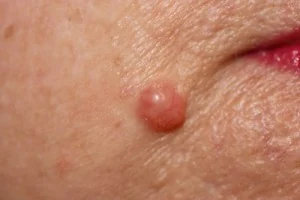
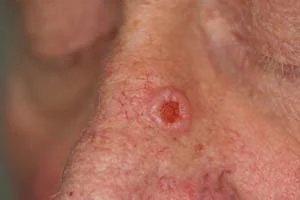
BCC
Basal cell carcinoma
The most common type of skin cancer. It often appears as a pearly or shiny lump, or a red, scaly patch, and usually grows slowly.
Skin cancer is the most common form of cancer, and Australia has one of the highest rates of skin cancer in the world. Here’s what to look for, and how it can be treated.
Skin cancers arise from the development of abnormal cells that can spread to other parts of the body. There are many types of skin cancer, but the three main types are basal cell carcinoma (BCC), squamous cell carcinoma (SCC) and melanoma.
More than 90% of skin cancer cases are caused by exposure to ultraviolet (UV) radiation from the sun.
Exposure to UV radiation increases the risk of all three main types of skin cancer, and exposure has increased partly due to a thinner ozone layer. People with light skin are more at risk of developing skin cancer, as are people with weakened immune function, including those living with HIV/AIDS.
Skin cancers can look very different from person to person. If you notice anything new or changing, book a skin check.
The most common type of skin cancer. It often appears as a pearly or shiny lump, or a red, scaly patch, and usually grows slowly.
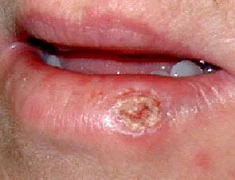
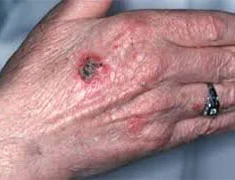
Often appears as a thickened, red, scaly spot that may bleed or ulcerate. It can grow quickly and can spread if left untreated.
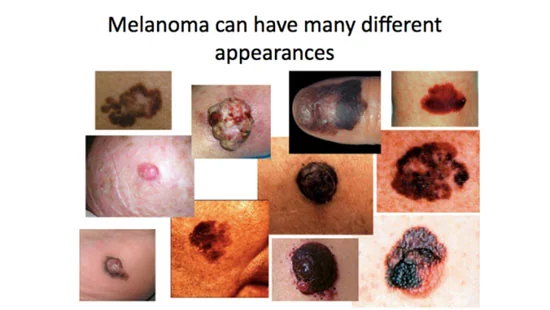
The most dangerous form of skin cancer. It can appear as a new spot or an existing spot that changes, and can spread if not found early.
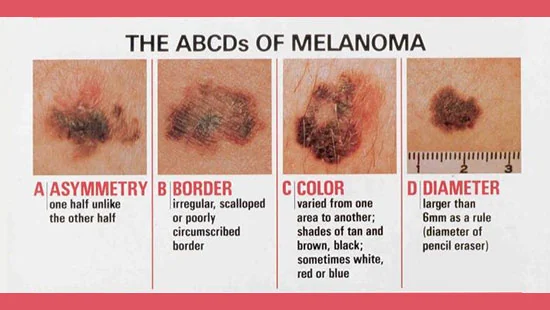
Use this simple guide when checking your skin, and see a doctor about any spot that worries you.
One half of the spot is unlike the other half.
An irregular, scalloped or poorly defined border.
Colour varies from one area to another, with shades of tan, brown and black, and sometimes white, red or blue.
Usually larger than 6mm, about the size of a pencil eraser.
A spot that is changing in size, shape or colour over time.
To help prevent skin cancers such as melanoma and squamous cell carcinoma, use sunscreen, avoid the midday sun and avoid tobacco products. Sunscreens containing zinc oxide and titanium dioxide help protect against both UVA and UVB radiation.
Treatment depends on the type of cancer, its location, whether it is a primary cancer or a recurrence, and the age of the person.
For low-risk disease, radiation therapy, topical chemotherapy and cryotherapy can provide adequate control of the disease, although they may have lower overall cure rates than certain types of surgery. Other treatment options include photodynamic therapy, topical chemotherapy, and electrodesiccation and curettage.
Mohs surgery is a technique used to remove the cancer with the least amount of surrounding tissue, with the edges checked immediately for any remaining tumour. This removes the least amount of tissue and provides the most cosmetically favourable results, which is especially important where excess skin is limited, such as the face. Cure rates are equivalent to wide excision. Special training is required to perform this technique. An alternative method, CCPDMA, can be performed by a pathologist not familiar with Mohs surgery.
Australia and New Zealand have one of the highest rates of skin cancer in the world, almost four times the rates registered in the United States, the UK and Canada. Around 434,000 people receive treatment for non-melanoma skin cancers and 10,300 are treated for melanoma. Melanoma is the most common type of cancer in people aged 15–44 in both countries, and the incidence of skin cancer has been increasing.
The incidence of melanoma among Auckland residents of European descent in 1995 was 77.7 cases per 100,000 people per year, and was predicted to increase in the 21st century because of “the effect of local stratospheric ozone depletion and the time lag from sun exposure to melanoma development.”
Early detection makes all the difference. Call 02 9623 7777 to book a bulk billed skin check.